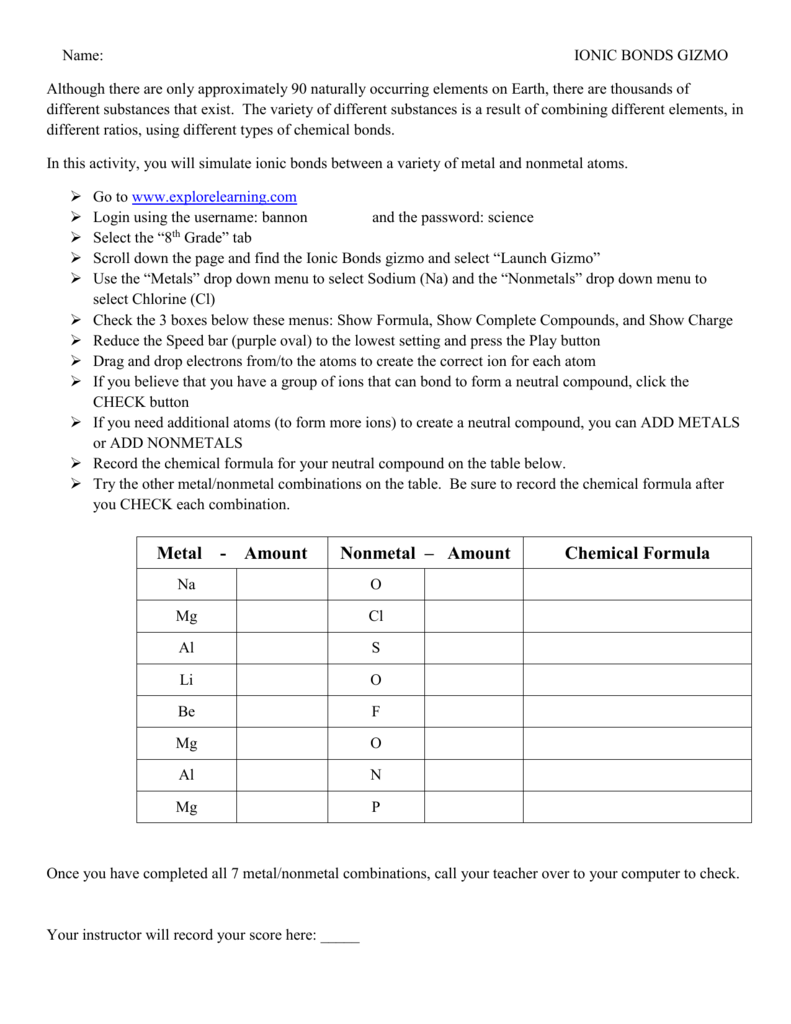
Exploring Ionic And Covalent Bonds Gizmo : Answer Key Student Exploration Ionic Bonds Gizmo Worksheet Answers + My PDF Collection 2021. Covalent bonds have a low polarity. Although there are only approximately 90 naturally occurring elements on earth, there are thousands of different substances that exist. A covalent bond is a bond that results from the sharing of pairs of electrons between two atoms. In a covalent bond, the atoms bond by sharing electrons. Combinations of metals and nonmetals typically form ionic bonds.
By doing this, atoms form bonds. Covalent bonds involve the sharing of electron pairs between atoms. To begin, check that sodium (na) and chlorine (cl) are selected from the menus at 1. 4 covalent bonding and orbital overlap we explore how electrons are shared between atoms in a covalent bond. We start exploring the covalent bond by looking at an example where the difference in electronegativity is zero.
Ionic bonds gizmo from s3.studylib.net An ionic bond is a bond that results from the attraction between oppositely charges ions; Electrons move around the nucleus of atoms in specific shells, shown by the rings around the atoms in the gizmo. Not assessed to ib criteria introduction: Covalent bonding is dominant in organic chemistry, but ionic bonds generally have higher dissociation energies. Ionic and covalent bonds hold molecules together. In a covalent bond, the atoms bond by sharing electrons. Ionic bonds are an extreme example of bonding if we confine ourselves to binary compounds, i.e. In this lesson students delve into covalent bonding through taking notes and practicing with whiteboards and individual practice.
Each atom consists of protons.
Describe the energetics of covalent and ionic bond formation and breakage. Ionic and covalent bonds are the two main types of chemical bonding. Ionic compounds have very high melting points and boiling points, compared to. Student exploration gizmo ionic bonds answers string stringbuffer stringbuilder string stringbuffer. We start exploring the covalent bond by looking at an example where the difference in electronegativity is zero. Exploring ionic and covalent bonds gizmo : There are eight markers in a full. Covalent bonds usually occur between ionic and covalent compounds also differ in what happens when they are placed in water, a exploring our fluid earth, a product of the curriculum research & development group (crdg). Although there are only approximately 90 naturally occurring elements on earth, there are thousands of different substances that exist. The two main types of chemical bonds are ionic and covalent bonds. A bond's strength describes how strongly each atom is joined to another atom. Covalent bond, diatomic molecule, lewis eight markers in a full set, but flora and frank each only have seven markers. Covalent bonds and ionic bonds are two different ways of how elements bond to each other.
Atoms bond together to form compounds because in doing so they attain lower energies than they possess as individual atoms, becoming more stable in the process. Ionic and covalent bonds are the two main types of chemical bonding. Exploring ionic and covalent bonds gizmo : Covalent bonds involve the sharing of electron pairs between atoms. The variety of different substances is a result of combining different elements, in different ratios, using different types of chemical bonds.
Exploring Ionic And Covalent Bonds Gizmo - Cierra_Esteen-_Ionic_Bonds_Gizmo_Student_WS_ - Name ... from lh6.googleusercontent.com One atom gives another atom an electron. Ionic and covalent bonds hold molecules together. Electrons move around the nucleus of atoms in specific shells, shown by the rings around the atoms in the gizmo. Select a metal and a nonmetal atom, and transfer electrons from one to the other. Covalent bond, diatomic molecule, lewis diagram, molecule, noble gases candy compounds teacher information i use this activity after we have discussed ionic and covalent bonds to give my students a chance to practice bonding. As you will see in the covalent bonds gizmo™, atoms form bonds in this way. Atoms bond together to form compounds because in doing so they attain lower energies than they possess as individual atoms, becoming more stable in the process. An ionic bond is a bond that results from the attraction between oppositely charges ions;
Simulate ionic bonds between a variety of metals and nonmetals.
Ionic and covalent bonds hold molecules together. The two main types of chemical bonds are ionic and covalent bonds. Covalent bonds and ionic bonds are two different ways of how elements bond to each other. Ionic bonds are an extreme example of bonding if we confine ourselves to binary compounds, i.e. Ionic bonding is modeled using an explorelearning gizmo. There are eight markers in a full. There are eight markers in a full. Science ionic and covalent bonds vocabulary. As mentioned above, ionic bonds are a result of electrostatic forces between atoms that get attracted towards each other due to the possession of opposite electrical charges. This is meant to introduce ionic and covalent bonding as well as the properties associated with the resulting compounds. Ionic and covalent bonds are the two main types of chemical bonding. I'm not sure why your friends have been led to believe that covalent bonds are stronger, as that's generally not true. The variety of different substances is a result of combining different elements, in different ratios, using different types of chemical bonds.
To begin, check that fluorine is selected. Not assessed to ib criteria introduction: Covalent bonds have a low polarity. Start studying covalent bonds gizmo. We start exploring the covalent bond by looking at an example where the difference in electronegativity is zero.
Ionic Bonds Gizmo Intro video - YouTube from i.ytimg.com Covalent bond, diatomic molecule, lewis diagram, molecule, noble gases candy compounds teacher information i use this activity after we have discussed ionic and covalent bonds to give my students a chance to practice bonding. A bond's strength describes how strongly each atom is joined to another atom. Ionic and covalent bonds are the two main types of chemical bonding. Atoms bond together to form compounds because in doing so they attain lower energies than they possess as individual atoms, becoming more stable in the process. I have students do an ionic compound quick review to. The first ring holds two. Jul 4th, 2021ionic bonds student exploration gizmo answer keyread pdf ionic bonds student exploration gizmo answer key before using the gizmo. Covalent bonds and ionic bonds are two different ways of how elements bond to each other.
Covalent bonds involve the sharing of electron pairs between atoms.
Jul 4th, 2021ionic bonds student exploration gizmo answer keyread pdf ionic bonds student exploration gizmo answer key before using the gizmo. The key difference between an ionic and covalent bond is that one atom essentially donates an electron to another atom in an ionic bond while electrons are shared between atoms in a covalent bond. The ionic bonds gizmo™ allows you to explore how. What are ionic and covalent bonds? Not assessed to ib criteria introduction: In a previous video we introduced ourselves to the idea of bonds and the idea of ionic bonds where one atom essentially is able to take electrons from another atom but then because one becomes positively charged and the. Ionic bonds are an extreme example of bonding if we confine ourselves to binary compounds, i.e. Student exploration gizmo ionic bonds answers string stringbuffer stringbuilder string stringbuffer. In this lesson students delve into covalent bonding through taking notes and practicing with whiteboards and individual practice. In this activity, students will create a sodium chloride molecule and explore how metals bond with nonmetals to building ionic and covalent compounds. Use simulation to observe properties of ionic and molecular compounds in conjunction with msds sheets. Select a metal and a nonmetal atom, and transfer electrons from one to the other. Ionic and covalent bonds hold molecules together.